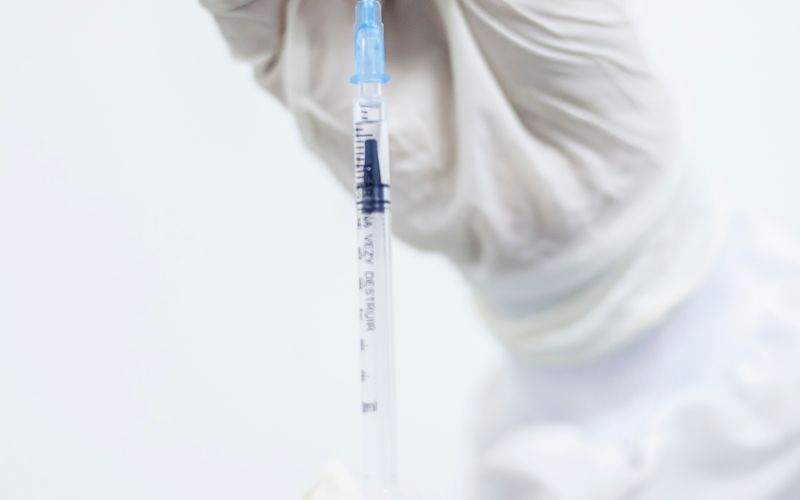
Why it arrives as powder
Peptides in solution are not durable. Left in water they hydrolyse, aggregate, and lose activity, and they do it faster when warm. So they are shipped lyophilised — frozen, then dried under vacuum so the ice leaves as vapour without ever melting. What is left is a dry cake or a scatter of powder holding the peptide's structure with the water taken out from underneath it.
Dry, it tolerates the days in transit that a solution would not. That protection ends the moment you add water. Everything after that is a clock: reconstituted peptide needs refrigeration and has a limited life, which is why you reconstitute when you are ready to start, not when the parcel arrives.
Vials often look nearly empty, or the powder looks like a smear on the glass rather than a neat pellet. At a few milligrams that is normal, and it is not evidence that you have been sent an empty vial. Some cakes also shift or crack in transit. Neither tells you anything about potency — only an assay does.
What you need
| Item | Why |
|---|---|
| Bacteriostatic water | Sterile water with benzyl alcohol added as a preservative, which is what allows a vial to be entered more than once. This is the usual choice for anything used over days or weeks |
| Sterile water for injection alternative |
No preservative. Effectively single-use, and the right choice only where a compound is documented as incompatible with benzyl alcohol |
| 1 mL insulin syringes | Fine graduations for measuring both the water going in and the dose coming out |
| Alcohol prep pads | For both rubber stoppers, every single time, including the first |
| A cleared, wiped surface and good light | You need to see the solution clearly, and you need somewhere clean to set things down |
| A sharps container | Set up before you start, not afterwards |
Benzyl alcohol is worth one line of caution: it is the reason bacteriostatic water works for multi-dose use, and it is also why bacteriostatic water is not appropriate for neonates and is generally avoided in pregnancy. If that applies to you, this is a question for a clinician rather than a forum.
Before you open anything
- Wash your hands properly, then sanitise. Not one or the other.
- Wipe the surface and let it dry, then lay everything out within reach so you are not hunting for a cap mid-procedure.
- Work out your water volume first. Deciding while holding a loaded syringe is how people end up guessing — see choosing how much water.
- Once you start, touch nothing sterile. Not the needle, not the inside of a cap, not the cleaned face of a stopper. If you touch any of them, replace the needle rather than hoping.
The procedure
- Uncap both vials. Flip off the plastic caps on the peptide vial and the bacteriostatic water to expose the rubber stoppers. The stopper itself stays on; you inject through it.
- Swab both stoppers with a fresh alcohol pad and let them air-dry. Drying is the part that does the work — going in wet drags alcohol into the vial and does not disinfect properly.
- Draw your water. Through the stopper of the bacteriostatic water vial, pull the volume you calculated. Expel air bubbles and check the number on the barrel before you withdraw.
- Add it against the glass. Insert through the peptide vial's stopper, angle the needle so the stream runs down the inside wall, and let it flow slowly. Do not fire it into the powder.
- Leave it alone. Give it a few minutes to dissolve on its own. If it needs help, roll or swirl the vial gently between your fingers.
- Look at it. Hold it to the light. You want clear and particle-free.
- Label it with the contents, the concentration you just created, and the date, then refrigerate.
Never fire the water directly onto the powder, and never shake the vial. Both subject the peptide to mechanical stress it does not need, and the standard practice across the field is to avoid them. Aim at the wall, then let dissolution happen slowly. Patience costs you five minutes; the alternative may cost the vial, and you will have no way of knowing it did.
Checking it worked
Most peptides give a clear, colourless solution. Some are faintly tinted, and that can be normal for the specific compound — the documentation should say. What you are looking for is what should not be there.
- Undissolved solids after a reasonable wait. Give it longer and swirl gently before concluding anything. Some compounds are slow.
- Cloudiness, haze, or floating particulates in something that should be clear. Do not inject it.
- Anything that has visibly changed since last time — new colour, new sediment, new film. Treat that as a reason to stop using that vial.
Write it on the vial
The single highest-value habit here takes ten seconds. Put the concentration and the date on the vial in marker, at the moment you create it.
A vial of clear liquid carries no information about itself. Three weeks later, with two vials in the fridge reconstituted at different volumes, memory is not a safe place to keep the number that determines your dose. Recording it also means you can reproduce the same preparation next time instead of re-deriving it. The calculation is in the arithmetic primer.
What not to do
| Do not | Because |
|---|---|
| Shake it | Mechanical stress the molecule does not need. Swirl, or wait |
| Blast water onto the powder | Same reason. Run it down the glass instead |
| Use tap, filtered or bottled water | Not sterile. Only bacteriostatic water or sterile water for injection |
| Use expired bacteriostatic water | The preservative is the point, and it is what expires |
| Freeze a reconstituted vial | Ice crystals damage what is dissolved, and it may not come back properly. Unless the documentation says otherwise, refrigerate |
| Combine compounds in one vial | You lose independent control of each dose and introduce interactions nobody has characterised |
| Skip the swab because the vial is new | Stoppers are not sterile on the outside. Every entry, every time |
| Reuse needles | Blunted tip, more tissue trauma, contamination carried in |
After it is mixed
- Refrigerate it. Cold slows the degradation that starts the moment water goes in.
- Treat the usable window as finite. The commonly cited 28 days is a microbial safety figure, not a promise the compound is still active. Those are two separate clocks, covered with per-compound windows in the storage primer.
- Keep it out of light and out of the fridge door, where the temperature swings every time it opens.
- One vial, one person. Multi-dose does not mean multi-user.
- When in doubt, bin it. A discarded vial is a small loss. An injected contaminated one is not.
Injection-site practice, rotation and sharps disposal are covered in the risk primer, along with the signs that an injection site is infected rather than just sore.
Before you act on any of this
This describes a general procedure for education. It is not a recommendation to use any compound, and preparing something correctly says nothing about whether you should be taking it. Doing this at home carries real infection risk, and the handling advice here does not replace the documentation for the specific product in front of you or the judgement of a qualified clinician.