Why the powder is stable
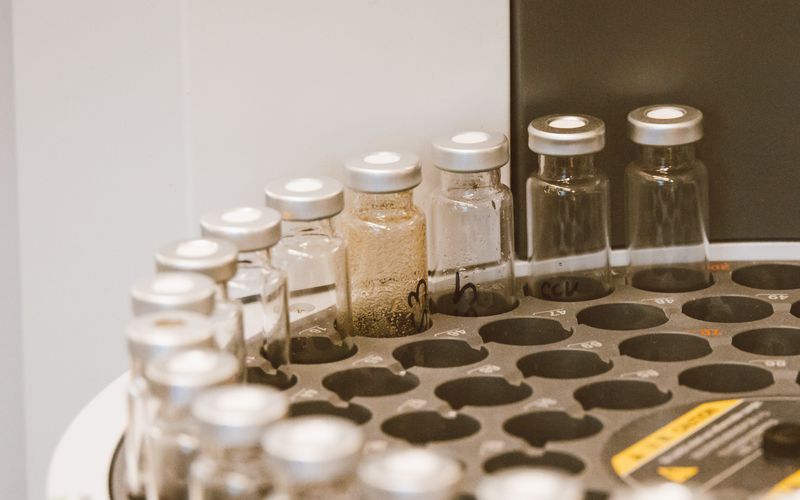
Lyophilisation freezes the solution and then pulls the water off under vacuum as vapour, without it passing through a liquid phase. What remains is not just dry peptide — it is peptide locked into a glassy solid, a rigid amorphous matrix with the molecular mobility of hard candy.
That rigidity is the whole point. Degradation reactions need molecules to move and meet. In a glass they cannot, which is why a properly stored lyophilised vial keeps for years while the same peptide in water is measured in weeks.
Every rule below follows from one idea: protect the glass, and once it is gone, slow down what replaces it.
The four things that degrade it
Moisture
A glass has a softening point — the glass transition temperature. Above it, the matrix turns rubbery, molecules regain mobility, and degradation restarts. Moisture drags that temperature down, steeply.
| Residual moisture | Approximate transition temperature | Meaning at room temperature |
|---|---|---|
| Near zero, as supplied | ~80 °C | Comfortably glassy |
| ~3% | ~50 °C | Still glassy, margin reduced |
| ~8% | ~25 °C | At or below room temperature — the glass is gone |
Representative figures for lyophilised peptide formulations. Actual values depend heavily on what else is in the cake, particularly sugar excipients. The pattern is the point, not the exact numbers.
This is the practical consequence, and it is the mistake that costs people vials
without their knowing. Take a vial from the fridge, pop the cap, and the cold
glass condenses water out of the room air onto your powder — the same way a
cold drink sweats.
Let it stand 15–30 minutes until it reaches room temperature before
opening. No temperature difference, no condensation. Do not speed it up
with heat.
Heat
Chemical reaction rates rise with temperature. As a working rule, every additional 10 °C roughly doubles the rate of degradation. A vial at 24 °C is degrading in the order of four times faster than the same vial at 4 °C.
Refrigeration is not a superstition, it is a rate control. It also means time on the counter is not free: an hour out is an hour spent at several times the cold rate.
Light
Ultraviolet light drives photo-oxidation of specific residues. Tryptophan is the most vulnerable, and it degrades badly: its oxidation products are themselves photosensitisers, so damage accelerates the conditions for further damage. Tyrosine, methionine and cysteine are also exposed.
Keep vials in their box, and off windowsills.
Oxygen
Methionine, cysteine, histidine, tryptophan and tyrosine all oxidise. Vials are sealed under vacuum or inert gas precisely to keep oxygen away from them — and every needle that goes through the stopper lets a little atmosphere in.
That is a reason to finish a vial within a sensible window rather than picking at it for months, and a reason not to enter it more often than the protocol requires.
The two clocks
Adding water starts two timers that measure different things. Conflating them is the most common misunderstanding in this whole subject.
| Microbial clock | Chemical clock | |
|---|---|---|
| Question | Could this give me an infection? | Does this still work? |
| Driven by | Contamination at each entry; whether a preservative is present | Hydrolysis, deamidation, oxidation, aggregation |
| Answer | A standard: 28 days, refrigerated, preserved, good technique | Different for every compound |
| Visible? | Sometimes — cloudiness, particles | Usually not at all |
The figure comes from pharmacy compounding standards for preserved multi-dose vials. It is a microbial safety limit, not a potency guarantee. A vial can be perfectly safe on day 27 and substantially degraded; it can also be chemically fine and contaminated on day 3. The two answers are independent, and the shorter of them governs.
What benzyl alcohol does, and does not
Bacteriostatic water is sterile water with roughly 0.9% benzyl alcohol. That preservative is what makes repeat entry into a vial reasonable.
It does: inhibit bacterial growth by disrupting cell membranes, and provide a mild local anaesthetic effect that some people notice as a less stinging injection.
It does not: kill bacteria outright — bacteriostatic means it suppresses growth, and it is not instantaneous, so contamination introduced at the moment of entry is not neutralised on contact. It has minimal antifungal and no antiviral action. And critically, it does nothing whatsoever about chemical degradation. It does not slow hydrolysis, deamidation or oxidation.
It can also make things worse. Benzyl alcohol is documented to destabilise some proteins, promoting partial unfolding and aggregation, in a concentration-dependent way. So bacteriostatic water is not "the better water". It is the right choice for multi-dose use over days or weeks, and the wrong one for several specific compounds.
Choosing the fluid
| Fluid | Use it when | Once opened |
|---|---|---|
| Bacteriostatic water 0.9% benzyl alcohol | Multi-dose use across days or weeks. The default | 28 days refrigerated |
| Sterile water for injection | Single day or single dose, or a compound that benzyl alcohol harms | Single use — discard |
| Sterile saline 0.9% | As above; isotonic, which some find more comfortable | Single use — discard |
| 0.6% acetic acid | Only where a compound specifically requires low pH — the IGF-1 analogues | Per label |
The compounds that break the default
Reaching for bacteriostatic water automatically is right most of the time and actively destructive for a handful of compounds. These are the ones worth knowing before you mix rather than after.
- IGF-1 LR3 and IGF-1 DES need 0.6% acetic acid. Bacteriostatic water degrades them quickly — on the order of a day or two rather than weeks. This is the single most expensive mistake on the page.
- Oxytocin is degraded by benzyl alcohol. Sterile water or saline.
- Desmopressin and vasopressin are likewise affected. Sterile water or saline.
- NAD⁺ oxidises fast whatever you use, and some sources prefer acetic acid.
- HCG is commonly reconstituted with bacteriostatic water, though some practitioners prefer saline.
Never freeze a reconstituted vial
Freezing dry powder is fine and is the right long-term storage. Freezing a solution is a different operation entirely, and it damages what is dissolved in it by four separate mechanisms.
- Ice crystals form and mechanically disrupt peptide structure.
- Freeze concentration. As pure water crystallises out, everything dissolved is forced into a shrinking volume of remaining liquid. Local concentration spikes, which drives aggregation.
- Surface denaturation. Ice presents an enormous surface area, and peptides adsorb to it and unfold.
- pH shifts. Buffer components crystallise at different rates, so the unfrozen fraction can swing well away from its intended pH.
The manufacturer's lyophilisation is a controlled process with protective excipients and a defined freezing profile. A domestic freezer is none of those things. If a vial freezes by accident: thaw it at room temperature, do not refreeze, use it promptly, and assume some loss.
The rules, condensed
| Stage | Do |
|---|---|
| Powder, long term | Freezer at −20 °C or colder, sealed, dark |
| Powder, medium term | Refrigerator at 2–8 °C, sealed, dark |
| Before opening | Stand 15–30 min to room temperature. Swab the stopper. Let it dry |
| After mixing | Refrigerate at 2–8 °C. Never freeze. Keep dark. Label with contents, concentration and date |
| Every entry | Swab the stopper again, every single time |
| Placement | Body of the fridge, not the door, where temperature swings |
What looking can and cannot tell you
Inspect before every use. Discard on any of these:
- Cloudiness or haze — aggregation.
- Visible particles — aggregation advanced enough to see.
- Colour change, particularly yellowing — often oxidation. Note that some compounds are legitimately coloured: GHK-Cu is blue, and AOD-9604 can look cloudy or gel-like normally.
- Gelling — severe aggregation.
- Any unusual smell.
A clear solution is not evidence of potency. Hydrolysis and deamidation cleave and alter peptides into inactive fragments that stay perfectly dissolved and perfectly transparent. Visual inspection catches gross failure. It cannot tell you a compound still works, and nothing available at home can.
Per-compound handling
Windows below are for reconstituted material held refrigerated, in the dark, with clean technique. The right-hand column is how good the stability evidence is — not how well the compound works. Those are different questions, and efficacy grades live on the foundations primer.
| Compound | Reconstitute with | Window | Data quality |
|---|---|---|---|
| 5-Amino-1MQ | Bacteriostatic | 14–30 d | Moderate |
| AICAR Nucleoside analogue; may degrade faster |
Bacteriostatic | 14–21 d | Low |
| AOD-9604 Cloudy or gel-like appearance can be normal |
Bacteriostatic | 28 d | Moderate |
| ARA-290 Little published stability data |
Bacteriostatic | 14–21 d | Low |
| BPC-157 Robust. Gastric-stability data comes largely from one research group |
Bacteriostatic | 21–30 d | Moderate |
| BPC-157 + TB-500 blend Use the shorter component's window |
Bacteriostatic | 14–21 d | Low |
| Cerebrolysin No reconstitution |
Supplied as liquid | Per label | High |
| CJC-1295 (no DAC) Shorter than the DAC version |
Bacteriostatic | 7–14 d | Moderate |
| CJC-1295 (with DAC) DAC extends half-life in the body, not shelf stability |
Bacteriostatic | 14–28 d | Moderate |
| DSIP Light sensitive |
Bacteriostatic | 14–21 d | Low |
| Epithalon | Bacteriostatic | 14–30 d | Moderate |
| FOXO4-DRI Very limited data |
Bacteriostatic | 14–21 d | Low |
| GHK-Cu Blue colour is normal. Do not combine with vitamin C |
Bacteriostatic | 21–30 d | Moderate |
| GHK-Cu blends Blue colour normal. Use the shortest component window |
Bacteriostatic | 14–21 d | Low |
| GHRP-2 | Bacteriostatic | 21–28 d | Moderate |
| GHRP-6 | Bacteriostatic | 21–28 d | Moderate |
| Glutathione Oxidises readily |
Sterile water | 7–14 d | Low |
| HCG Well characterised |
Bacteriostatic or saline | 28–30 d | High |
| Hexarelin | Bacteriostatic | 14–28 d | Moderate |
| HMG | Bacteriostatic | 14–21 d | Moderate |
| IGF-1 DES More fragile than LR3 |
0.6% acetic acid | 7–14 d | Low |
| IGF-1 LR3 Bacteriostatic water degrades it. Acetic acid is required, not optional |
0.6% acetic acid | 30+ d | High |
| Ipamorelin | Bacteriostatic | 28 d | Moderate |
| Kisspeptin-10 Limited data |
Bacteriostatic | 14–21 d | Low |
| KPV | Bacteriostatic | 21–28 d | Low |
| LL-37 | Bacteriostatic | 14–28 d | Moderate |
| Melanotan II Safety context in the route primer |
Bacteriostatic | 14–21 d | Moderate |
| MGF Less stable than most |
Bacteriostatic | 7–14 d | Low |
| MOTS-c Notable degradation by around day 30 |
Bacteriostatic | 14–30 d | Moderate |
| Afamelanotide (MT-1) | Bacteriostatic | 21–28 d | Moderate |
| NAD⁺ Oxidises quickly |
Bacteriostatic or acetic acid | 7–14 d | Low |
| Oxytocin Not bacteriostatic water — benzyl alcohol degrades it |
Sterile water or saline | 14–21 d | Moderate |
| PEG-MGF PEGylation improves stability over plain MGF |
Bacteriostatic | 21–28 d | Moderate |
| Pentadeca arginate Arginate salt of BPC-157 |
Bacteriostatic | 21–30 d | Moderate |
| Pinealon | Bacteriostatic | 21–28 d | Low |
| PT-141 Protect from light |
Bacteriostatic | 30 d | Moderate |
| Retatrutide Not sterile water |
Bacteriostatic | 14–28 d | Low |
| Selank Nasal preparations may be shorter |
Bacteriostatic or saline | 30–60 d | Moderate |
| Semaglutide Licensed products give 56 days in use. Not saline |
Bacteriostatic | 28–56 d | High |
| Semax Saline preferred for nasal use |
Saline (nasal) | 20–30 d | Moderate |
| Sermorelin Among the more stable |
Bacteriostatic | 30–90 d | Moderate |
| Somatropin (HGH) About 24 h without preservative. Handle gently |
Bacteriostatic | 28 d | High |
| SS-31 | Bacteriostatic | 30–42 d | Low |
| TB-500 | Bacteriostatic or saline | 28–30 d | Moderate |
| Tesamorelin | Bacteriostatic | 28 d | Moderate |
| Thymalin Limited data outside Russian sources |
Bacteriostatic | 14–21 d | Low |
| Thymosin alpha-1 | Bacteriostatic | 14–28 d | Moderate |
| Tirzepatide Not saline. Licensed presentations are single-dose, so no in-use figure transfers directly |
Bacteriostatic | 28–30 d | Moderate |
| VIP Light sensitive |
Bacteriostatic | 14–21 d | Low |
| Vitamin B12 Light sensitive |
Supplied as liquid | Per label | High |
High means manufacturer specifications or peer-reviewed data. Moderate means suppliers broadly agree and there is a chemical rationale. Low means sources conflict or the figure is extrapolated from general principles. Where sources disagreed, the shorter window is shown.
What this cannot tell you
Most of these compounds are sold as research chemicals, and research chemical suppliers are not required to run the stability programmes that licensed manufacturers run. So a large share of the numbers above — here and in every other guide of this kind — are extrapolated from peptide chemistry, taken from limited supplier data, or borrowed from a microbial standard that was never about chemical potency in the first place.
What is solid:
- Cold slows degradation. This is basic kinetics and applies to everything here.
- Light damages photosensitive residues.
- Freezing a solution causes real, characterised damage.
- Unpreserved solutions support bacterial growth.
- 28 days is a defensible, conservative microbial window.
What varies by compound: how fast it actually degrades in solution, what pH suits it, and which degradation route dominates.
What nobody can tell you from a webpage: the potency of your vial today, whether your particular handling has cost you anything, and whether what you have is what the label says. Only an assay answers those.
Where sources conflict, take the shorter window. Where there is no data, assume 14–21 days. For blends, inherit the least stable component. If a vial has been warm, bright or frozen, shorten it or discard. If it looks wrong, discard. A replacement vial costs less than an infection or a wasted month of protocol.
Before you act on any of this
This page is about handling and chemistry, not about whether to use anything. It contains no doses. Storage figures are best-available estimates, several of them weak, and none of them a guarantee about the vial in front of you. Product documentation and a qualified clinician both outrank this page.
Sources
Compiled from pharmacy compounding standards for sterile preparations, prescribing information for licensed somatropin, semaglutide and tirzepatide products, published work on peptide and protein stability, freeze-thaw damage and photo-oxidation, peptide manufacturer handling guidance, and cross-referenced supplier documentation. Where supplier documentation was the only source, that is reflected in the data-quality column.